Interfaces & gcloud
Interfaces
There are four ways to reach the same resources - pick the one that fits the task, they all drive the same APIs underneath.
Cloud console
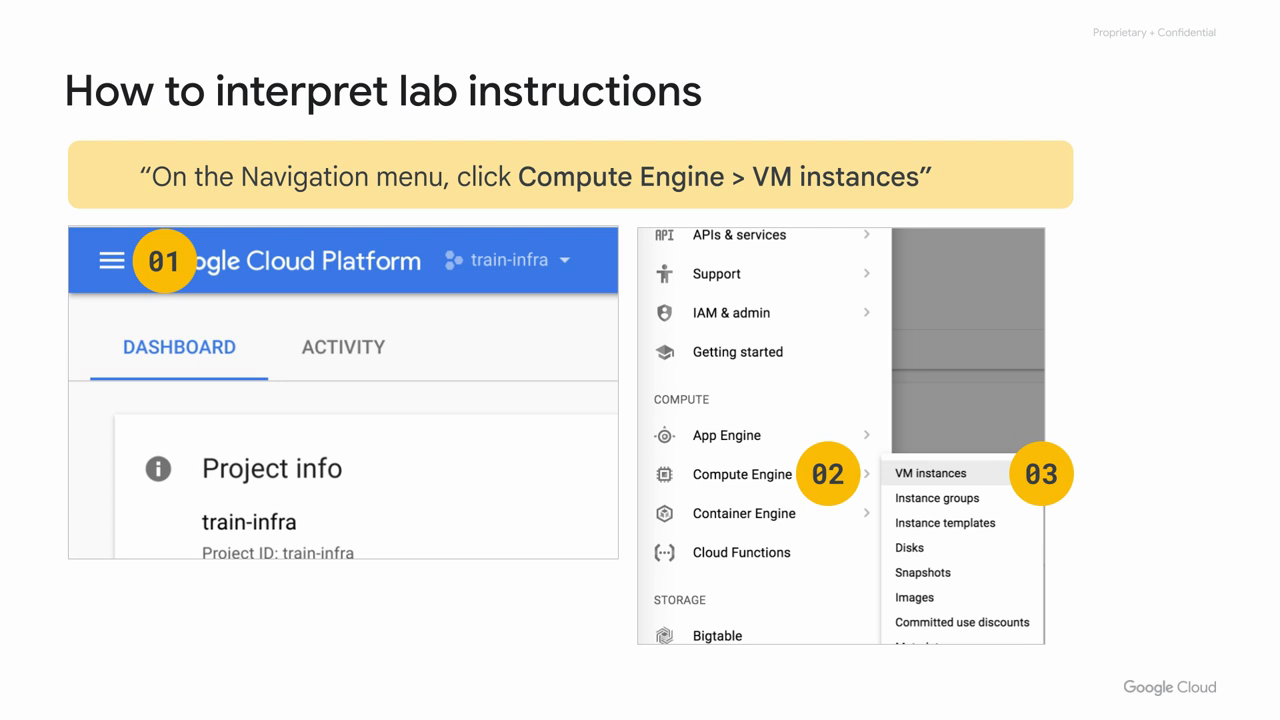
The console is the web GUI at console.cloud.google.com - a point-and-click view of every resource in your projects (VMs, buckets, billing, and so on).
Cloud Shell + CLI
The gcloud CLI does the same as the console from a terminal
(e.g. gcloud compute instances list) - see the gcloud section below
for its command families and configuration model. Cloud Shell is a browser
terminal you open from the console - a temporary VM with 5 GB of persistent
disk and the CLI pre-installed, so you never install anything locally. It
also offers web preview to test web apps running on the Shell VM over a
temporary URL.
The VM is recycled after 1 hour of inactivity, and closing the terminal resets it. Only the /home directory (5 GB) survives; env vars, installed packages, and system config are lost. A new VM is allocated each session.
REST API + libraries
Beyond the CLI, client libraries let your code create and manage resources. They expose two kinds of API:
- App APIs - access to services, optimised per language (Node.js, Python, …).
- Admin APIs - resource management, for building your own automation tools.
The libraries wrap Google Cloud's RESTful API (GET/POST/PUT/DELETE, JSON),
and OAuth 2 handles authentication.
The console's APIs Explorer lists every available API and version and lets you call them interactively in the browser - including calls that require user authentication - which is handy for learning an API before you write code.
Cloud Mobile App
Manage Google Cloud from an Android or iOS device: start, stop, and SSH into Compute Engine instances, manage database instances and App Engine apps, read logs, chart key metrics (CPU, network, requests/sec, server errors) on a customizable project dashboard, handle incident management, and get billing and budget alerts. Free from Google Play or the App Store.
Cloud Marketplace
Cloud Marketplace deploys pre-configured, ready-to-run solutions (a LAMP stack, WordPress, Jenkins, and so on) with no manual VM, network, or storage setup. It gets its own page - see Cloud Marketplace.
gcloud
The gcloud CLI is the primary command-line tool for Google Cloud: a set of
command families, named configurations that bundle your defaults, and its own
authentication model.
Command families
Picking the wrong tool for the resource is a classic distractor.
Configurations
A configuration is a named bundle of account, project, and default
region/zone. Switching configs is how you jump between projects or identities without
retyping flags.
Without the .profile line you'd have to re-source the file every session. Env vars cut typos in repeated gcloud flags (region/zone/project).
Authentication
Prefer attached service accounts or Workload Identity over downloaded keys.
Recap
gcloud (+ service account)